No More
When I was a child, most of the adults around me smoked cigarettes. In restaurants, on airplanes, waiting in lines at the movies. Smoke billowing into faces, filling public spaces, anddefining a certain kind of cool. When I was a child, people who got behind the wheel of a car after they’d had too much to drink received a slap on the wrist if they were stopped. They were tolerated, even accommodated, and you were prudish or over-sensitive if you suggested that it be otherwise.
But something happened in the past two decades in America. Groups of passionate people banded together and took on the tobacco industry. Everyday citizens started organizations like Mothers Against Drunk Driving, and slowly but surely the public dialogue changed. Cigarettes became linked to Cancer instead of Cool, and driving while drunk came to be seen as the height of criminal selfishness. The people of our country collectively, over a period of time, said “No more” to these two habits which had seemed so inevitably ingrained in our society.
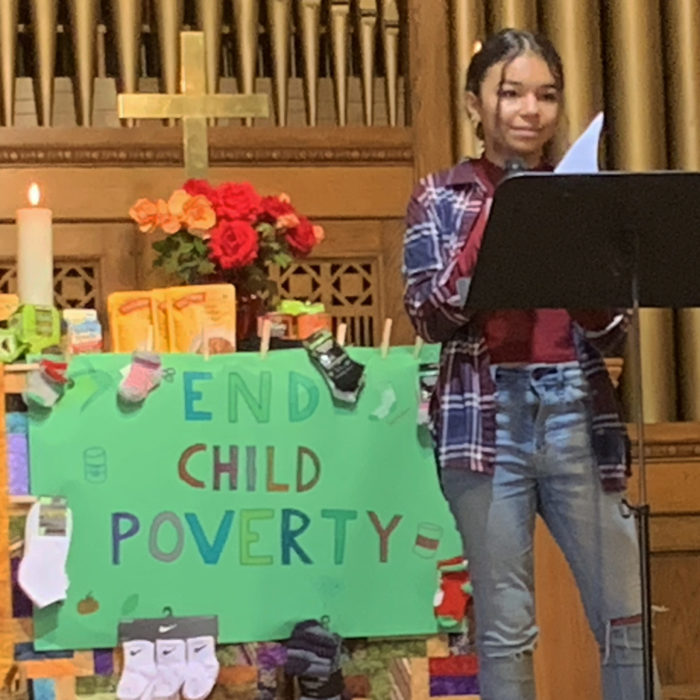
It’s time to do that again. For far too long we have allowed millions of people to go hungry in the United States. 48 million people — including 16.2 million children- go hungry every day. 14.5% of the people who live in the richest country in the world don’t get enough to eat. It seems both impossible to believe and impossible to change. It seems like too big a problem. But it’s not.
Hunger is a problem that can be solved. We have enough food in this country that everyone can be fed. We have the tools and the technology such that none of our neighbors need ever be hungry again. The only thing that stands in our way is the will to say “No more.” No more hungry children, no more blaming poor families, no more under-nourished seniors. We have enough to go around, if we choose to make it so.
This past April, Patti Bury and I attended the Second Harvest Food Bank’s annual “Make Hunger History Awards.” We went to represent this congregation as we received the Spirit Award for the Outstanding faith-based food drive in Santa Clara and San Mateo counties. We were honored because of your history of giving to Second Harvest and the innovative way we incorporated our food drive into the 150th Anniversary Celebration. It was inspiring to listen to the stories of other honorees from companies, and schools, and non-profits, who had banded together last year to change the way we talk about and deal with hunger. Some of the activists were CEO’s of large companies and organizations; some of the activists were teens; two of the award winners were under 13 years old. What they had in common was a belief that the long-time societal acceptance of hunger could be changed.
During the month of May we are collecting food for Second Harvest and for families of the Hoover Learning Center. Please give generously, as you always have. We will also be learning more about issues related to hunger, like food accessibility and poverty and legislative policy. Let’s use our collective voice and our actions to help shift our national dialogue. It can happen. We need only decide: ”No more.”
Kim
They will hunger no more, and thirst no more the sun will not strike them, nor any scorching heat For the Lamb at the center of the throne will be their shepherd and will guide them to springs of the water of life and God will wipe away every tear from their eyes.(Revelations 7:16-17)
Are You a Follower?
Is there a distinction between being a believer in Christ and a follower of Jesus? That question was posed to us at Annual Gathering, and I have been pondering it ever since.
87 times in the gospels Jesus used the word “follow” when he laid out what he wanted us to do. Follow. Not explain, ortheorize, or philosophize. Those things, while interesting, allow us to keep a distance from Jesus, as if studying him is enough. Following requires actively responding. Following requires really looking at the ways Jesus lived and died — and then shaping our own lives accordingly. Early followers referred to this as The Way, and it was a real path for them.
As Christian communities became more settled and structured, and as the Church grew into an institution, the focus shifted. Creeds and doctrines became more and more important as a means of bringing uniformity to the movement and identifying who was “in” and who was “out.” What one believed became the litmus test of whether or not one was a true Christian, and thus long Confessions and Credos were taught and memorized, and Christians began to define themselves by the words they said.
Always, however, there were those among us who reminded us of the original call: to follow Jesus. From Francis of
Assisi to the nuns on the bus (look them up! http://www.networklobby.org/nuns-bus-trip),
there have been Christians in our midst whose lives witness to the power of simply following Jesus. Love God. Love one another. Take care of the least among you. Turn away from the need for power over others, and find a way to serve. Let go of the desire for more money than you need, and make your treasure count. Choose community over individualism. It’s a counter-cultural call, because The Way of Jesus is really, truly counter-cultural.
At our finest, Christian communities help each other to stay true to the call to follow. Yes, we veer into doctrine and
intellectualism sometimes. But it is in hearing together the stories of Jesus and sharing together how they have an impact on our lives that we become followers.
It is a fine thing to be a believer in Christ. But are you a follower of Jesus?
May it be so. Kim

The Songs We Sing
Were you ever told to “Think before you speak?” If you had conscientious parents, as I did, you probably heard that many times in your growing up. Not because impulsive thoughts are bad, but because we know words can help or harm a situation — or person. So we think before we speak (sometimes) and try to do the best we can with the words we have.
Were you ever told to “Think before you sing?” Not as likely. So often we sing along with the radio, or sing the words of a hymn or praise song at church, and let the music carry us away, leaving the words far behind us. This weekend at the Annual Gathering for the Northern California/Nevada UCC, Rev. Bryan Sirchio, a songwriter and longtime UCC minister, challenged us to think more about the theology we sing.
His book, The 6 Marks of Progressive Christian Worship Music, led us in an encounter with Christian music — new and old– that shapes our faith. His own music is a gift to the church, in that it is contemporary and deeply grounded in a theology we can claim. All 6 characteristic bear talking about, but the one that I want to highlight is #4: An emphasis on both the individual and the community.
Much of the newer Christian music is almost exclusively about a personal relationship with Jesus. ”I and Me” music. The more we actually listen to Jesus, though, the more we know that a personal relationship is only the beginning. Jesus “called his disciples to be a part of a community…we don’t always need other people in order to be closer to God personally, but to be a Christian is to be a follower of Jesus, and Jesus was about creating a people — not just a bunch of individual believers.” (Sirchio)
Please notice: he didn’t say that a personal relationship with God is unimportant or unnecessary. He just linked it, as did Jesus, to our relationship with community, and suggested that everything in our fellowship, including our music, “remind us that we need each other to truly follow in the ways of Jesus… ”
We do need each other. The work we do, the grief and the joys we share, the faith we express: all are richer when we join with other followers of Jesus. How will you join with others to live out your call this summer? How will you join your voice with those of other Christians so that the songs we sing — of love, of justice, of hope — can be heard in a world waiting to hear?
Kim
ASH WEDNESDAY SERVICE
February 13, 2013
12:00 noon
Chapel
You are invited to join us for a simple service of prayer and the imposition of the ashes as we begin the season of Lent. Psalm 51 reads: ”Create in me a clean heart, O God, and renew a right spirit within me.” As we receive the ashes, we open our hearts to be fashioned anew. It is a privilege and a joy to walk the path toward Easter together, as we listen together for the still-speaking God in our midst.

BELIEFS MATTER
How do people act in times of disaster? Do they fall apart or pull together? Do they rise above the circumstances or sink to the lowest common denominator of human behavior? Think back about what you know about disasters. Perhaps you were here during the Loma Prieta Earthquake. Or maybe you were in New York on 9/11. My home town has been completely evacuated twice in the last ten years due to forest fires, and I have heard stories of long caravans of cars, winding down the one mountain road, leaving burning homes behind them. What do you know about how people treat each other in the worst of times?
I ask because I am reading a book called “A Paradise Built in Hell,” by Rebecca Solnit. The entire book is an examination of disaster sociology: that is, the study of how people interact in a crisis. It could be a dry topic, I suppose, with more academic than real world import, except that Solnit makes a very timely point: what we believe about human nature in times of disaster will determine how we treat the people who encounter them. In other words, beliefs matter. If you believe that most people are basically bad, waiting for an opportunity to loot and kill, you will spend your resources trying to set up defenses and protections; if you believe that most people are basically good and will try their best to help others in times of need, you will spend your resources sending in aid and trying to assist. For example, after the hurricane in New Orleans, disaster victims were held at gunpoint as they tried to cross the bridges out of the inner city into the safer suburbs. Because the officials in charge assumed that the (mostly black) refugees would become an unruly mob, they were forced to stay in the heart of the devastation, without basic services or help for days. Many died as a result. Likewise, just after the 1906 earthquake and fire in San Francisco, the officials in charge reacted to the citizens as if they were criminals, and instead of aiding them, tried to “keep them under control,” often spending more time arresting people than helping them. The irony is, in these two cases and in virtually every other case studied, ordinary people were doing the right thing. More than that, they went above and beyond in their outreach to one another. Solnit writes:
In the wake of an earthquake, a bombing, or a major storm, most people are altruistic, urgently engaged in caring for themselves and those around them, strangers and neighbors as well as friends and loved ones. The image of the selfish, panicky, or regressively savage human being in times of disaster has little truth to it. Decades of meticulous sociological research…have demonstrated this. But belief lags behind, and often the worst behavior in the wake of a calamity is on the part of those who believe that others will behave savagely and that they themselves are taking defensive measures against barbarism.
Jesus said, “Love thy neighbor as thyself.” And then he went on to tell a story about a Samaritan who risked his life for a stranger. How very different is this belief than the ones we’ve been hearing lately, as representatives of the gun industry seek to stoke our fear of strangers with images of “bad guys” who need to be stopped — with guns, of course. How very different is Jesus’ belief from those who would have us build an ever higher wall, with ever bigger militias, to keep the “dangerous” immigrant away, or call for massive prisons, in the midst of cutbacks to schools.
We have a body of evidence that shows that as imperfect as we are, human nature is much better than that. We follow a teacher who told us that the most important thing we can do is to care for and value the lives of those around us. Both of these stand in stark contrast to the messages of fear and hatred that exist in our culture. Beliefs matter. They shape laws. They shape lives. As we encounter some very tough issues in our country, may we stand up against the bunker mentality that has infected our culture for too long. We believe that, even in the toughest times, we can count on our faith and on one another.
May it be so. Kim
UCC Call to Action
So many of you have expressed your deep concern about the recent gun violence in our country. Many different stakeholders have given input to the Gun Violence Task Force. The President has proposed a plan to address these issues. The momentum on this issue is growing, as people of faith join other citizens in demanding change. The following is a statement by the United Church of Christ, with some suggested steps for us to take. I hope you will read it and give prayerful consideration to the actions you can take on this issue. If our faith asks nothing else of us, it asks this: that we make sure the children in our midst are safe and cared for. May we join all together to make the changes necessary for this new reality.
Kim
* * *
Despite the unrelenting and terrible toll taken by gun violence year after year in the United States, Congress has done distressingly little to address what has become a major public health threat. While tragic incidents of gun violence like the shootings at Sandy Hook Elementary School, Aurora, Colorado and Oak Creek, Wisconsin draw national headlines, in many communities across the country, the impact of gun violence is a day-to-day reality.
The public dialogue about gun violence can quickly become divisive. However, as several prominent leaders from both major political parties have noted, the complex and emotional dynamics that underlie gun violence cannot be an excuse for inaction. The cost of gun violence, which is seen in lives lost and forever altered; in the medical and criminal justice expenses; in ever increasing security requirements; and in quality of life diminished by fear of gun violence, is too high. Our nation must begin to take concrete steps to address it.
Background
Long before the tragic massacre at Sandy Hook Elementary School last December, members of the faith community have steadfastly advocated for sensible, responsible policies to end gun violence. In 1995, The UCC 20th General Synod passed a resolution entitled “Violence in Our Society and World,” in which it recognized the complicated and interwoven layers at the root of violence.
That same General Synod also passed a resolution entitled “Guns and Violence,” inviting UCC members and congregations to advocate for legislation to strengthen licensing and registration of gun sales, strengthen regulations of gun dealers and ban semiautomatic assault weapons and high capacity ammunition clips.
The faith community has come together many times in the aftermath of gun tragedies to urge lawmakers to pass laws that prevent gun violence. Tested by our grief, resolute in our faith we remain committed to continuing this drumbeat.
Take Action – Send a letter or join an interfaith call-in day on February 4th!
It will take a multilayered approach to address the prevalence of gun violence, but we can begin now. Although no one piece of legislation will provide a solution, meaningful legislative steps can help reduce the toll of gun violence. You can ensure that the voice of faithful Americans rings throughout the halls of Congress. On February 4th, call your members of Congress and insist that they act to prevent gun violence. Call the Capitol Switchboard at 202.224.3121 and ask to be connected to your legislators.
Urge members of Congress to:
Reinstate the expired assault weapons ban
(bills were recently introduced in both the House and Senate);
Institute universal background checks;
Ban high-capacity ammunition magazines.
It’s time to turn our shared grief into collective action.
If you prefer to write a letter:
Go to this article on the on the UCC website to submit a letter,
Or write to: Senator Barbara Boxer 312 North Spring Street #1748 Los Angeles, CA 90012 and/or Senator Dianne Feinstein 331 Hart Senate Office Building U.S. Senate Washington, DC 20510160 Birch Street
Suite B
Redwood City, CA
94062
(650) 369-0344
- May 2013
- February 2013
- January 2013
- December 2012
- November 2012
- October 2012
- September 2012
- August 2012
- July 2012
- June 2012
- May 2012
- April 2012
- March 2012
- February 2012
- January 2012
- December 2011
- November 2011
- October 2011
- September 2011
- August 2011
- July 2011
- June 2011
- May 2011
- April 2011
- March 2011